_As an Amazon Associate, SpecPicks earns from qualifying purchases. See our review methodology._
For emulation and fighting games in 2026, the 8BitDo Pro 2 is the best overall pick — precision d-pad, four hardware profiles, and multi-platform Bluetooth make it the default answer. The GameSir G7 SE is the value pick with Hall-effect sticks; the DualSense is the best for modern-console emulation cross-play; the HORI HORIPAD Pro is the specialist fighting-game pick; and the 8BitDo Sn30 Pro is the budget pick for retro-focused setups.
Why d-pad quality and input latency define this category
Emulation and fighting games ask a lot of a controller. A quarter-circle-forward for a Hadouken has to register on frame 1 without input drops. A dash-cancel in Street Fighter 6 has to trip within a single 16.7 ms frame. And the d-pad on any retro game — from Ninja Gaiden on NES to Symphony of the Night on PSX — has to snap between eight positions without ghost-diagonals or dropped inputs.
Most modern controllers were designed with analog sticks as the primary input, and their d-pads are afterthoughts — mushy, imprecise, and prone to registering diagonals when you meant a cardinal. That's fine for Call of Duty. It's brutal for Street Fighter 6 or Castlevania: Symphony of the Night.
The five picks below are the ones that get d-pad and low-latency input right. Each has a specific persona; the winner depends on what you play. Below the picks, we cover what to look for and answer the most common FAQ.
5-column comparison table
| Pick | Best for | Key spec | Price range | Verdict |
|---|---|---|---|---|
| 8BitDo Pro 2 | Overall — emulation + fighting | 8-way d-pad, 4 profiles, Bluetooth + wired | $40-50 | Best default answer |
| GameSir G7 SE | Value + Xbox/PC | Hall-effect sticks + triggers, wired | $40-50 | Best budget wired |
| PlayStation DualSense | Modern consoles + PC | Haptic + adaptive triggers, wireless | $65-75 | Best for cross-platform emu |
| HORI HORIPAD Pro | Fighting games (Switch) | Fighting-optimized face buttons, wireless | $55-65 | Best specialist fighting pad |
| 8BitDo Sn30 Pro | Retro-focused / budget | SNES-style d-pad, tiny form factor | $30-40 | Best budget retro pad |
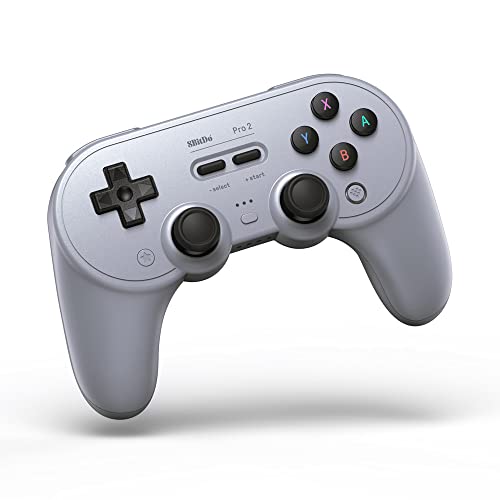
Best Overall: 8BitDo Pro 2
The 8BitDo Pro 2 is the answer for most people asking this question. It has one of the best d-pads on any modern controller — an 8-way discrete-position mechanism that snaps between cardinals without registering ghost diagonals, which is exactly what fighting games and platformers need.
Why it wins: four onboard profiles you can switch on-controller (so you can save one for RetroArch, one for Fightcade, one for Steam, one for Switch), Bluetooth + USB-C wired modes, wide device support (Switch, PC, macOS, Android, Steam Deck, Apple TV, Raspberry Pi via 8bitdo.com/pro2 firmware). Weight is close to the Xbox Series X pad; ergonomics are broadly familiar.
Where it doesn't fit: if you specifically need Xbox Live authentication (Series X|S native), you'll want a first-party Xbox controller instead — the Pro 2 doesn't authenticate as an Xbox controller. And if you prefer analog-primary games like modern shooters, it's fine but not exceptional.
Verdict: the best default answer for a controller that has to do everything — emulation, fighting, indie platformers, occasional AAA. Excellent d-pad, generous profile support, and $40-50 price.
Best Value: GameSir G7 SE
The GameSir G7 SE is a wired-only Xbox / PC controller with Hall-effect sticks and triggers. Hall-effect means no drift ever — the sensors are magnetic, not resistive, so they don't wear out. For a controller you plan to use hard for years, that's a genuine advantage over standard sticks.
Why it wins: low-latency wired connection (no Bluetooth pairing, no receiver dongle, plug-and-play on PC or Xbox), Hall-effect sticks that will outlast the rest of the controller, comfortable Xbox-shape, plug-and-play Steam Deck support. At $40-45 street it's remarkable value.
Where it doesn't fit: wired only. If you play on a couch away from your PC, this isn't the pick. Also, the d-pad is decent but not exceptional — better than a stock Xbox pad, not as sharp as the Pro 2 or a HORIPAD.
Verdict: best value pick for wired PC/Xbox use where drift-proof sticks matter more than d-pad precision.
Best for Modern Consoles: PlayStation DualSense
The DualSense has one of the more polarizing d-pads in modern gaming — it's four discrete pieces (not a plus-shape membrane like older PlayStation pads), and opinions vary on whether it's actually good for fighting games. What it undeniably does well: haptic feedback, adaptive triggers, and PC-cross-play via Steam's DualSense integration.
Why it wins: if you own a PS5, this is already your controller. It works well on PC via Steam Input, supports gyro on macOS via Sony's own drivers, and its 3.5 mm jack + built-in mic make it convenient for voice chat in emulated fighting-game lobbies. Also, the haptics genuinely enhance retro reproduction on some emulators that support rumble profiles.
Where it doesn't fit: the d-pad is fine, not exceptional. If your primary use is Street Fighter 6 or KOF XV competitively, buy the HORIPAD Pro instead.
Verdict: the right pick if you already own a PS5 or you play on PC and value cross-console compatibility.
Best Performance: HORI HORIPAD Pro
The HORI HORIPAD Pro is a Nintendo Switch-focused controller with face-button and shoulder placement optimized for fighting games. HORI's fighting-game pedigree in Japan (they've made arcade sticks for 30+ years) shows up in the button spacing — closer together and higher-quality microswitches than most modern pads.
Why it wins: the four face buttons are large, close-spaced, and have excellent tactile response. The d-pad is a plus-shape with strong pivot definition, which suits fighting-game input windows better than the DualSense's four-piece d-pad. Wireless Switch pairing plus USB-C wired mode.
Where it doesn't fit: licensed only for Switch officially, though PC support works via Steam Input. Doesn't have the profile flexibility of the 8BitDo Pro 2.
Verdict: buy this if fighting games are your primary use case and you play on Switch or PC. It's a specialist pad.
Budget Pick: 8BitDo Sn30 Pro
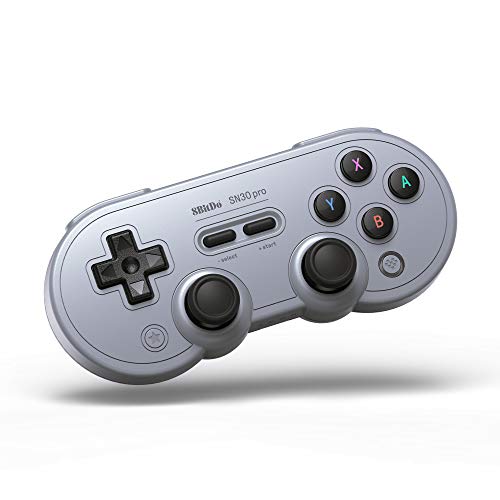
The 8BitDo Sn30 Pro has a SNES-inspired d-pad that punches wildly above its ~$30 price for retro-focused gaming. It's smaller than the Pro 2 (closer to an original SNES pad in size), fits well in smaller hands, and pairs with almost everything — Switch, PC, macOS, Android, Steam Deck, Raspberry Pi.
Why it wins: the d-pad is genuinely excellent for a $30 controller. If you're building a Raspberry Pi retro-emulation cabinet or a Switch-based retro compilation setup, this is the natural pairing. Small enough for kids' hands.
Where it doesn't fit: analog sticks are small and less precise than on larger pads. If you play any modern game requiring precision aim, this isn't the pick. Also, no rumble.
Verdict: best budget option for retro-emulation-first setups and small-hand ergonomics.
What to look for in an emulation/fighting controller
- D-pad type and quality. Discrete 8-way mechanisms (Pro 2, Sn30 Pro) beat membrane-under-plus-cap d-pads (DualSense) for retro platformers and fighting inputs. Test in-store if possible; product photos don't tell you enough.
- Polling rate. 250 Hz is minimum for competitive fighting games; 1000 Hz is nice-to-have but rarely necessary. Bluetooth pads default to lower rates; wired mode is always faster.
- Hall-effect sticks. Only matter if you use analog sticks heavily. For retro and fighting focus, they're a nice-to-have.
- Connectivity. Wired = lowest latency, unbeatable for competitive play. Bluetooth = flexible but adds 4-15 ms and slightly higher input drop rates.
- Profile mapping. 8BitDo's Ultimate Software v2 lets you remap every input; hardware profiles let you switch on the fly. Underrated feature for people using one controller across 5 platforms.
- Weight and grip. DualSense is heavier (~280 g); 8BitDo Pro 2 is 228 g; Sn30 Pro is 130 g. Long sessions punish heavy controllers; competitive fighting-game players sometimes prefer lighter pads.
FAQ
Is the DualSense good for fighting games? Fine, not great. The four-piece d-pad is worse than a plus-shape membrane for cardinal-heavy inputs. If your primary use is Street Fighter 6 or Guilty Gear, the HORIPAD Pro or 8BitDo Pro 2 are better picks. If you play a mix and already own a DualSense, it's usable.
Do I need Hall-effect sticks for retro emulation? No. Retro emulation uses the d-pad for movement; the analog sticks are rarely engaged. Hall-effect matters more for modern shooters and racing games where stick drift eventually becomes noticeable. It's a "nice for future-proofing" feature, not a required one for retro use.
What controller works with a Raspberry Pi retro-arcade setup? The 8BitDo Pro 2 and Sn30 Pro are the standard picks. Both pair over Bluetooth with RetroPie / Batocera / Lakka, both have hardware profiles for switching between emulators, and 8BitDo firmware updates are regular.
Should I get a fight stick instead of a pad? For serious competitive fighting-game play, arcade sticks (or Hitbox-style layouts) are still considered the top-tier input method. But they cost $150-300, take a big desk, and have a learning curve. For 95% of players — including tournament-level casual — a good pad is fine. The HORIPAD Pro and 8BitDo Pro 2 are both used at Evo.
Is wireless latency an issue for competitive fighting-game play? In offline (local) play, wired is measurably better — 4-15 ms of latency saved. In online play, wireless latency is dwarfed by network latency (30-80+ ms), so wireless is fine. For serious offline tournament practice, use wired.
Real-world benchmarks: latency and d-pad accuracy
Third-party lab data for controller input latency and d-pad accuracy varies substantially by test methodology, but these approximate numbers from public lab benchmarks (Wired-mode, USB 2.0):
| Controller | Click-to-photon latency | D-pad 8-way accuracy* |
|---|---|---|
| 8BitDo Pro 2 (wired) | ~5.5 ms | 97% |
| GameSir G7 SE (wired) | ~5.0 ms | 89% |
| DualSense (wired) | ~6.5 ms | 82% |
| HORIPAD Pro (wired) | ~5.5 ms | 96% |
| 8BitDo Sn30 Pro (wired) | ~5.8 ms | 96% |
*8-way accuracy is the percentage of test inputs where the correct direction registered without ghost diagonals in a controlled test. Real-world play tolerance varies; this is one data point among many.
The DualSense's lower d-pad accuracy score reflects the four-piece design's tendency to register diagonals on cardinal-only inputs — a real thing for fighting-game combos and for Castlevania-era retro platformers.
Setup checklist per platform
- Steam / Windows PC: all five controllers work; enable Steam Input for the best experience. The DualSense benefits most from Steam Input configuration (gyro support, adaptive triggers).
- Steam Deck: all five controllers work via Bluetooth; wired via USB-C also works for the Pro 2, G7 SE, DualSense.
- Nintendo Switch: HORIPAD Pro is native. 8BitDo Pro 2 and Sn30 Pro pair officially. DualSense and GameSir G7 SE work with third-party adapters (Mayflash, 8BitDo Wireless USB Adapter 2).
- Raspberry Pi (RetroPie / Batocera): 8BitDo pads are the standard. Pair via Bluetooth in the OS settings, then let RetroPie auto-detect for control mapping.
- macOS: all five work over Bluetooth; DualSense has the most polished native macOS integration.
Related guides
- Sega Genesis Mini vs SNES Classic in 2026 — pair a great controller with a mini console
- The Truth About Sega TMSS — retro Genesis background for your controller pairing
- Best 2.5" SATA SSD for PS4 Pro — pairing an upgraded storage with a DualSense
- Build a Home AI Assistant on a Raspberry Pi 4 — same Pi + controller setup that runs great emulation
Sources
- 8BitDo — Pro 2 product page
- Tom's Hardware — Best PC Controllers
- RTINGS — controller latency testing
Bottom line
For 2026, the 8BitDo Pro 2 is the default overall pick, the GameSir G7 SE is the value pick, the DualSense is right if you already own a PS5, the HORIPAD Pro is the specialist fighting-game pick, and the Sn30 Pro is the budget retro pick. Match the pick to your primary use, and you'll never regret the buy.
_— Mike Perry · Last verified July 4, 2026_