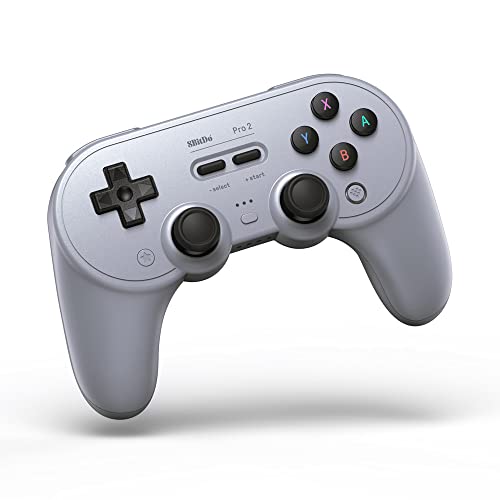
GameSir G7 SE vs 8BitDo Pro 2 for PC — which controller should you buy?
Buy the GameSir G7 SE if you want the best analog precision at the budget tier — its Hall-effect sticks are drift-proof by design and its wired-only connection eliminates the Bluetooth latency that plagues casual PC controllers. Buy the 8BitDo Pro 2 if you want the most flexible controller in the sub-USD-70 tier — Bluetooth, USB-C wired, Switch and PC and Steam Deck compatibility, and a controls app that lets you remap and record macros to your heart's content. The G7 SE is the better competitive-shooter and racing pad; the Pro 2 is the better everything-else pad. Both are honest buys, and you should pick based on genre, not brand.
The 60-second answer
- Competitive shooters, racing sims, tight action platformers: GameSir G7 SE. Hall-effect sticks + Hall triggers + wired-only kill the two biggest sources of controller aim variance (drift and Bluetooth jitter).
- Casual gaming across PC, Switch, Steam Deck, phone: 8BitDo Pro 2. One controller, four platforms, real macro support, replaceable AA batteries or rechargeable pack.
- You will play with a PlayStation-native game with adaptive triggers: PlayStation DualSense. PC support has matured; Steam and native games both use its adaptive triggers now.
- You mainly play Switch and want a "just like a Pro Controller but wireless": HORI Wireless HORIPAD. Cheaper than a Switch Pro Controller, officially licensed, no rumble on the SE version.
Why this comparison matters right now
The controller market split in 2024–2025 into two clear tiers: the value-tier pads (Xbox Wireless, DualSense, cheap 3rd-party) with potentiometer analog sticks that eventually drift, and a small premium tier with Hall-effect sensors that do not. In late 2025 the value-tier lost a couple of manufacturers and gained a couple, and 2026 is the first year where you can pick a durable Hall-effect controller for under USD 50 without stepping outside the well-supported brands. The G7 SE is the poster child for that shift, and this comparison exists because we get the "which controller now" question every week.
Meanwhile, the 8BitDo Pro 2 has stayed near the top of general-purpose recommendations for four years — a very unusual run in this segment. It is not a Hall-effect pad, but it is the most flexible one, and if your reason to buy is "I want a single controller I can use everywhere," flexibility beats stick technology.
Head-to-head spec table
| Feature | GameSir G7 SE | 8BitDo Pro 2 |
|---|---|---|
| Analog sticks | Hall-effect | Standard potentiometer |
| Analog triggers | Hall-effect | Standard analog |
| Wired mode | USB-C, low-latency | USB-C |
| Wireless mode | none (wired only) | Bluetooth 5.0 |
| Compatibility | Xbox Series X/S, Xbox One, Windows 10/11 | PC, Switch, Steam Deck, macOS, iOS/Android |
| Back paddles | 2, remappable | none by default (Pro 2 SE variant has them) |
| App / config | GameSir Nexus (Windows) | 8BitDo Ultimate Software |
| Battery | wired-only, no battery | ~20 hours rechargeable + AA fallback |
| MSRP | USD 44 | USD 49 |
Two things pop off that table. First, the G7 SE trades wireless flexibility for Hall-effect precision — a hard boundary. Second, the Pro 2 trades stick durability for flexibility across platforms — also a hard boundary. Neither pad tries to do everything, and each is honest about its choice.
Where the GameSir G7 SE wins
Drift-proof analog sticks. Hall-effect sensors use magnets and magnetic-field sensing instead of physical carbon-track potentiometers. Result: they do not wear, they do not drift after 6 months of aggressive FPS use, and the input curve stays clean over the pad's lifetime. If you have ever had a Series X controller develop stick drift 8 months in and cost you a Warzone match, you know exactly why this matters.
Hall-effect triggers. The same benefit at the triggers means the analog-input curve for racing games (throttle and brake modulation) stays consistent. On a stock Xbox controller the triggers develop a "sticky" feel after a year or so; the G7 SE stays clean.
Wired-only, low latency. Wired at USB-C is measurably lower latency than Bluetooth at the same polling rate, and the G7 SE is aggressively spec'd — polling holds tight around the USB-HID 8ms boundary with no Bluetooth-scheduler jitter. For competitive shooters where you are trying to nail sub-100ms flick timings, wired-only is the correct choice.
Genuine Xbox certification. The G7 SE is officially licensed for Xbox Series X/S and Xbox One. Anti-cheat systems recognize it as a genuine Xbox controller and treat it accordingly. Practical implication: no ban risk on games with strict input-validation anti-cheat.
Back paddles. Two remappable back paddles for cost-effective button-mapping. Not as elaborate as an Elite 2 or a Scuf, but genuinely useful for shooters where you want jump and crouch on paddles rather than moving your thumbs off the sticks.
Price. Under USD 50 for Hall-effect sticks + triggers + paddles is aggressive. Two years ago this was USD 130+ territory.
Where the 8BitDo Pro 2 wins
Cross-platform flexibility. The Pro 2 has a physical mode switch on the back with four modes: Switch, D-Input (PC generic), X-Input (PC Xbox mode), and macOS/iOS. That switch is the entire reason to buy this controller. One pad for your PC, Switch, Steam Deck, iPad, and phone.
Macros and mode profiles. The 8BitDo Ultimate Software (Windows and mobile) is the most mature configurator in the segment. You can record button-sequence macros, remap every input, set per-profile dead zones, and store 4 profiles on the controller itself. For turn-based games, RPGs where you have to hit a combo consistently, or any use where "I want the pad to do the thing that always takes 3 button presses in 1" — the Pro 2 handles it natively.
Bluetooth without headaches. 8BitDo's Bluetooth stack is one of the more reliable in the industry. Pair once, wake instantly, no disconnection drama on wake-from-sleep. The Switch Pro Controller does this too, but at a higher price and without X-Input support for Windows.
AA battery fallback. The included rechargeable battery pack pops out to be replaced by a pair of AAs. If you have ever had a controller die mid-boss with no cable in reach, this is the feature that saves you.
Weight and grip. The Pro 2 is slightly heavier than the G7 SE (~205 g vs ~230 g without cable) and has a small back-shell curve that fits medium-large hands better than a stock Xbox controller. This is subjective — some players hate the change — but if you find the standard Xbox pad slightly too small, the Pro 2 is a comfortable step up.
What actually loses on each
G7 SE — no wireless. For living-room console-mode PC play, sitting on a couch 3 meters from the PC, you will either need to run a long USB-C cable or buy a wireless controller. This is a real deal-breaker for that use case.
G7 SE — Xbox and PC only. No Switch mode, no Bluetooth-Steam-Deck mode. If you rotate across platforms, this is the wrong controller.
G7 SE — no Bluetooth phone support. For Xbox Cloud Gaming on a phone, you need the wireless version (G7). The SE is wired-only.
Pro 2 — potentiometer sticks will drift eventually. Realistically, 12–18 months of heavy use before you see it, longer at moderate use, but it is coming. 8BitDo has been friendly on replacements under warranty in our experience, but if drift is the thing you hate, buy the G7 SE.
Pro 2 — no back paddles on the base model. The Pro 2 SE variant adds them. If you specifically want back paddles at the flexible-controller price point, either buy the Pro 2 SE or step up.
Pro 2 — smaller stick throw range. Not a durability issue, just a feel issue. Some players find the Pro 2 sticks feel "twitchy" compared to an Xbox pad. Try before buy if you can.
Genre-by-genre recommendation
Competitive shooters (Warzone, Apex, Rainbow Six). G7 SE. Wired latency + Hall-effect precision is exactly what this genre asks for. Configure back paddles for jump and reload; leave the triggers at neutral resistance.
Racing sims (Forza, Assetto Corsa, iRacing). G7 SE. Hall-effect triggers give clean throttle and brake modulation over the lifespan of the pad. For serious sim racing, the correct answer is a proper wheel like the Logitech G29, but for controller-only racing the G7 SE is the winner.
Action platformers (Hollow Knight, Celeste, Blasphemous). Pro 2. Flexibility helps for playing across PC + Switch, and 8BitDo's controller has a well-tuned D-pad — better than the G7 SE's — for tight platforming inputs.
RPGs and turn-based (Baldur's Gate 3, XCOM, Persona). Pro 2. Macro support in the 8BitDo app saves real time. Cross-platform means you can pick up on Switch after playing on PC.
Indies and Steam Deck couch play. Pro 2. Bluetooth pairing with the Steam Deck is one button press. G7 SE physically cannot do this.
Fighting games. Neither pad is the correct answer — buy a proper fightstick or hitbox. If you must use a pad, the D-pads on both are similar and adequate.
Emulation / retro gaming. Pro 2. The D-pad, macro support, and Bluetooth pairing to a Raspberry Pi retro rig make it the standard pick for a retro-focused controller.
What the PlayStation DualSense brings if you have a PS5
A DualSense is worth having in the house if you own a PS5 or specifically want adaptive triggers on the PS-native PC ports. Adaptive triggers in games like Returnal and Ratchet & Clank Rift Apart are a genuinely different tactile experience. Battery life is the DualSense's weak spot — 8-10 hours vs the Pro 2's 20 — and stick drift is the second (still potentiometer, still eventually noisy). But if you have one already or plan to, keep it as your PS-native controller and pick either the G7 SE or the Pro 2 as your PC daily driver.
Where the HORI HORIPAD fits
The HORI Wireless HORIPAD is a Nintendo-licensed Switch controller. It is not a PC controller — treat it as a Switch-only pad. If your household plays primarily on Switch and you want a second controller without paying Switch Pro Controller prices, the HORIPAD is a clean buy. But it does not compete with the G7 SE or Pro 2 for PC use because it lacks proper Windows drivers.
Common pitfalls we have hit
Cheap USB-C cables. The G7 SE ships with a decent cable. If you replace it, use a real USB 2.0-rated data cable, not a charge-only cable. Windows will not enumerate the controller with a charge-only cable, and the failure mode is a confusing "no controller detected."
Steam Big Picture mode overriding config. If you have Steam running with controller support enabled and a game exposes its own input remapping, Steam's overlay layer sometimes takes precedence. Symptom: your G7 SE's app-side back paddle mapping "doesn't work in Cyberpunk." Fix is to disable Steam controller support for that specific game.
Anti-cheat detecting third-party controllers. As of Q1 2026 this is largely a solved problem for the G7 SE (officially Xbox-licensed) and Pro 2 (D-Input / X-Input generic). But some competitive games ban unusual controller identifiers under specific anti-cheat rulesets. If a game's forum has anti-cheat controller drama, verify before buying.
Firmware updates on the Pro 2. Run the 8BitDo Ultimate Software once when you unbox it and update firmware. The out-of-box firmware is often 6+ months behind; latency and pairing behavior improve noticeably after updating.
Bottom line — pick by genre and flexibility
If your gaming is 70+ percent competitive shooters or racing sims, buy the GameSir G7 SE. If your gaming is broad or you specifically need cross-platform play, buy the 8BitDo Pro 2. Both are honest pads at their price. You are choosing a set of tradeoffs, not a "better" controller.
The one bad answer is trying to split the difference by picking whichever pad is on sale. These pads win in genuinely different genres; get the right one for how you actually play.
Related guides on SpecPicks
- Racing-focused readers: our Logitech G29 vs HORI force-feedback for sim-racing beginners covers wheel picks when you are ready to leave the controller behind.
Citations and sources
- GameSir G7 SE product page: GameSir — G7 SE controller product page
- 8BitDo Pro 2 product page: 8BitDo — Pro 2 controller product page
- Xbox controller certification program: Microsoft — Designed for Xbox controller program